
Outlining is your secret weapon against writer's block and burnout

At the moment, I'm living in cramped accommodation with no heat or hot water while we wait for the completion of the endless renovations of our Italian house to end. Add to that working in corporate tech, managing the Writing Grove and trying to learn Italian, I don't have much brain capacity for writing.
But that doesn't mean I'm ignoring my novel. When life and work feel like too much, I outline. When I can’t bring myself to write full scenes or even full sentences, I outline.
It’s a way of staying close to the story without carrying the pressure of actually writing it. Instead of forcing the words onto the page, I focus on the structure underneath them.
And by thinking in shorthand, I often make interesting discoveries.
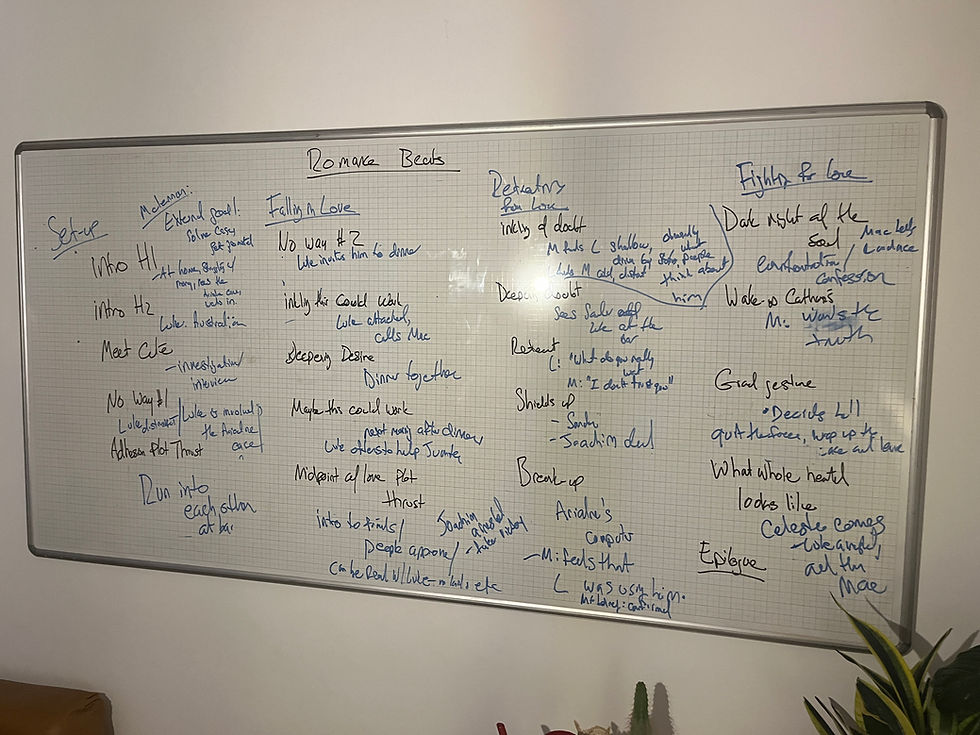
The blank page can feel intimidating. When you sit down to write a scene, there is often a quiet pressure to make it good. That it should be interesting, polished, maybe even brilliant. That pressure can easily turn into resistance.
Outlining removes that pressure.
When you outline, you’re not trying to write beautifully. You’re simply trying to understand the story better. You’re mapping what happens and why it matters. In many ways, outlining is like tidying up your ideas before you begin the real work.
Sometimes I outline on the computer. Sometimes I do it by hand. Often, I use a spreadsheet.
Databases are really just sophisticated spreadsheets, and what is a spreadsheet but a digital table? Rows and columns that allow you to organise information in a way your brain can actually see. Once you start arranging scenes this way, patterns appear. You begin to notice gaps, weak spots, and moments where the tension could be stronger.
So I draw the lines, create the columns, and get to work. And almost every time, the story starts moving again.
What Is an Outline?
At its simplest, an outline is a way of organising the building blocks of your story. It helps you see the shape of the narrative before you fully write it.
Instead of thinking about your book as hundreds of pages you have to produce, an outline breaks the story into manageable pieces. Scenes, events, and turning points become visible.
You begin to understand not just what happens in your story, but how one moment leads to the next. An outline acts like a map. It doesn’t replace the journey of writing the book, but it shows you the terrain you’ll be travelling through. When you know roughly where you’re going, it becomes much easier to move forward.
Some writers prefer simple outlines with a few bullet points per chapter. Others build more complex systems that track characters, timelines, emotional shifts, clues, and subplots. Both approaches are valid. The right outline is simply the one that helps you see your story more clearly. And it can be as simple as a table on a whiteboard or a spreadsheet.
Different Stories Need Different Outlines
The structure of your outline often depends on the type of story you’re writing.
A fantasy novel, for example, may require columns that track elements such as magic systems, worldbuilding details, political factions, and the internal logic of the setting. A historical novel may need space to record real historical events, cultural contexts, and how fictional characters intersect with actual events.
A crime or mystery novel might focus on evidence, suspects, timelines, and the timing of key clues' revelation to the reader.
The details vary by genre, but certain elements tend to remain consistent across most stories. Writers often track scenes, conflict, and the shift that happens by the end of each scene. Stories move forward when something changes, and an outline helps you see those changes clearly.
The Three Questions That Strengthen Every Scene
One of the most useful things an outline can do is help you examine the purpose of each scene. A helpful way to do this is by asking three simple questions.
What does the character want in this moment? Every scene works best when a character is trying to achieve something. That goal creates forward movement and gives the scene direction.
What gets in the way of that goal? Conflict is the engine of story. It can come from another character, a difficult situation, an emotional obstacle, or even the character’s own fears.
What changes by the end of the scene? Something must shift. Perhaps the character learns new information, makes a decision, faces a setback, or uncovers a new problem.
When your outline includes these elements, you’re already building the foundation of strong storytelling.
Why Outlining Helps When Writing Feels Difficult
If you sit down to write a scene but you’re unsure where it starts, what the conflict is, or how it ends, your brain naturally resists the work. Writing feels overwhelming because you’re trying to invent the story and write it at the same time.
Outlining separates those two processes.
Instead of solving everything in the moment of writing, you begin by exploring the structure of the story. You ask questions, sketch possibilities, and experiment with different directions. Once the shape of the scene becomes clear, writing it becomes far less intimidating.
In this way, outlining becomes a powerful antidote to writer’s block. It gives you a way to keep working on your story even on days when writing sentences, paragraphs, or pages feels difficult.
Your Outline Is a Tool, Not a Rule
One of the biggest misconceptions about outlining is that it locks a writer into a rigid plan.
In reality, an outline is simply a thinking tool. It can change as your story evolves. Scenes can move. Characters can take unexpected directions. Entire sections can be removed or rewritten. The outline adapts alongside the story.
Its purpose is not to trap your creativity but to support it. By giving you a clear view of the structure, an outline frees you to focus on the craft of storytelling.
A Simple Way to Start Outlining
If you’re new to outlining, the easiest way to begin is to keep it simple.
Take out a piece of paper, or go to a whiteboard, or open a document or spreadsheet and create three columns: one for the scene description and what happens in it, one for the characters in the scene want, and one for what changes by the end of it. Then start filling it in.
And just like that, you're editing, plotting, building character and conflict all without having to write a complete sentence. And the best part is, you can spend as long or as little time as you have, and still make big progress.


Comments